
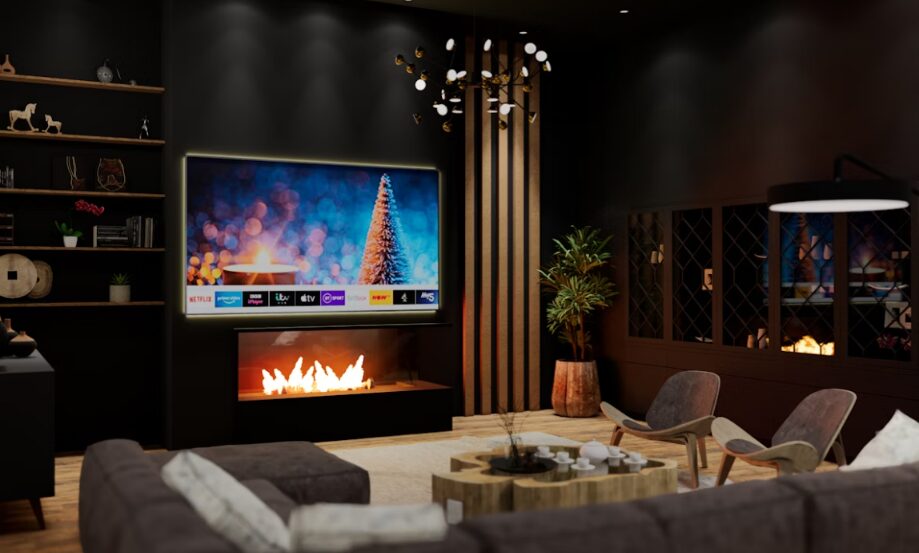
If you spend enough time in the AV enthusiast community, you will notice a recurring phenomenon. Home theater builders will obsessively research bitrates, debate the merits of HDMI 2.1 bandwidth, invest thousands of dollars in discrete Dolby Atmos speaker arrays, and painstakingly calibrate their audio receivers. Yet, when it comes to the visual centerpiece of their home theater, they will point a cutting-edge optical engine at a piece of primed drywall or a cheap, motorized sheet of white vinyl.
In the realm of projection technology, the light source is only 50 percent of the equation. The surface that catches, processes, and reflects that light back to your eyes is the other 50 percent. If you are integrating a high-end projector into your tech ecosystem, treating the display surface as an afterthought is the fastest way to bottleneck your entire system. Here is a deep dive into the optical engineering of projection surfaces, and why an Ambient Light Rejecting surface is a mandatory component for the modern media room.
The White Wall Fallacy
To understand why advanced screens are necessary, we must first address the most common sin in home theater setups: projecting onto a bare wall.
A standard wall is an isotropic scatterer. When light hits it, it disperses the photons equally in all directions—up to the ceiling, down to the floor, and sideways to the adjacent walls. This creates a light bleed effect that illuminates the entire room, which in turn washes out the image on the wall. Furthermore, standard interior paint has a specific color temperature that alters the precise white balance your projector is trying to achieve. Add in the microscopic texture of drywall, and you are introducing physical distortion to your 4K pixel grid. You are essentially taking a pristine, high-fidelity light beam and passing it through a dirty, textured filter.
The Evolution of the Light Engine
The urgency for specialized optical surfaces has accelerated rapidly due to the shift in projection hardware. We have moved far beyond dim, bulb-based units that require a pitch-black, windowless basement. Today’s standard for premium home cinema is increasingly built around advanced laser projection and UST placement.
Specifically, Ultra Short Throw laser technology has disrupted the AV market by allowing users to place the projection hardware on a media console just inches from the wall. These laser engines output massive amounts of brightness with strong color capabilities. However, because a UST projector sits at the bottom of the display area and fires light upwards at an incredibly steep angle, a standard projection surface simply cannot handle the light path correctly.
The Physics of Standard Matte White Screens
If a wall is terrible, a standard matte white projection screen is only a marginal step up for a living room environment. A matte white screen has a gain of 1.0 or 1.1, meaning it reflects light relatively evenly. While it solves the texture and color temperature issues of a painted wall, it suffers from the exact same fatal flaw in a mixed-use space: it cannot distinguish between the light coming from your projector and the ambient light in the room.
If you have a window open, or a lamp turned on, that ambient light hits the white screen and is reflected back to your eyes right alongside the projector’s light. The result is that black levels are completely destroyed. Black, in projection terms, is simply the absence of light. If ambient light is hitting the screen, the darkest your blacks can ever be is the color of the screen in that lighting condition, which is usually a washed-out, milky gray. Your contrast ratio collapses, and the image looks flat and lifeless.
Optical Engineering: How ALR Technology Works
This is where optical engineering steps in. To preserve the incredible contrast ratios generated by modern laser engines, you must pair them with a specialized UST projector screen equipped with Ambient Light Rejecting technology.
ALR screens, and specifically lenticular CLR screens designed for UST projectors, are not just flat pieces of fabric. They are highly engineered, multi-layered optical lenses. If you were to look at a UST ALR screen under a microscope, you would see a series of horizontal, sawtooth-like ridges running across the material.
This micro-structure does two things simultaneously:
Light Absorption: The top-facing side of these microscopic ridges is coated in a light-absorbing black material. When ambient light shines down from your ceiling fixtures or scatters from windows, it hits this black layer and is absorbed.
Targeted Reflection: The bottom-facing side of the ridges is coated in a highly reflective material. When the steep-angled light from your UST projector fires upward, it hits this reflective surface and is bounced directly outward, horizontally, straight into the viewing area.
The Result: Contrast Is King
By selectively rejecting overhead and off-axis ambient light while perfectly reflecting the projector’s beam, an ALR screen physically protects the black levels of your image. This allows a laser projector to maintain strong perceived contrast even in a living room with the blinds open and the lights on. The perceived brightness increases, the colors retain their vibrant saturation, and the image mimics the deep, punchy aesthetic of a massive OLED television panel.
For users planning a living room upgrade, an all-in-one UST projector setup becomes far more effective when the screen is treated as part of the optical system, not as an optional accessory.
Conclusion: The Surface Is the Lens
In the high-end AV world, we understand that you would never put cheap, budget tires on a high-performance sports car, as they are the only part of the vehicle that actually touches the road. The exact same logic applies to home theater visual tech. The screen is the only part of the system that actually interfaces with your eyes.
Investing in cutting-edge laser projection hardware is a fantastic way to elevate your home media experience, but that hardware cannot defy the laws of physics on its own. The display surface must be treated as an active optical component of the system. Upgrading to a premium ALR screen is not just an accessory; it is the critical final step required to unlock the true potential of your AV setup.
 Sufyan amir